
Spiritual healing, from a biblical perspective, refers to the restoration of a person’s relationship with God and the resulting wholeness that flows from His presence, power, and purpose. This includes physical healing performed by God through prayer and faith, emotional and mental restoration through Christ’s redemptive work, and deliverance from spiritual bondage.
The question of whether spiritual healers are real matters deeply because it touches both your faith and your wellbeing. You’re right to approach this with both curiosity and caution. Scripture affirms that God heals and that He works through believers filled with the Holy Spirit, but it also warns against false prophets and practices rooted in deception. The challenge isn’t whether spiritual power exists (it absolutely does), but rather discerning its source and whether those claiming to heal operate under God’s authority or another influence entirely.
This article will help you understand what genuine biblical healing looks like, how God’s healing power actually works through faith and prayer, and how to distinguish between Spirit-led healing and counterfeit practices that can lead you away from Christ. We’ll examine what Scripture teaches about healing gifts, explore the different forms spiritual healing takes in Christian practice, and give you practical wisdom for evaluating anyone who claims to operate in healing ministry.
Whether you’ve witnessed something that left you wondering, you’re considering seeking help from a spiritual healer, or you simply want to understand what the Bible teaches, you’ll find clarity grounded in God’s Word and applicable to the questions you’re facing right now.
What Spiritual Healing Means in a Biblical Context
In Scripture, spiritual healing refers to restoration that comes directly from God’s power rather than human ability or technique. Biblical healing centers on God’s sovereignty, He is the source, the healer, and the one who determines when and how healing occurs. This stands in contrast to practices that attribute healing to human energy, mystical forces, or spiritual entities outside the biblical framework.
The Christian understanding of healing rests on three pillars: God’s authority over sickness and health, the power of prayer offered in faith, and submission to His will. Exodus 15:26 establishes this foundation when God declares, “I am the Lord, who heals you.” Throughout Scripture, healing flows from relationship with God, not from techniques or rituals performed independently of Him. When healing happens, it testifies to God’s compassion and power, not to the healer’s abilities.
- Spiritual healing
- Restoration of physical, emotional, or spiritual wholeness through God’s direct intervention in response to prayer and faith.
- Divine healing
- Healing that originates from God’s supernatural power, distinguishing it from natural recovery or medical treatment alone.
- Faith healing
- The practice of seeking physical restoration through trust in God’s promises and power, often involving prayer by believers.
- Laying on of hands
- A biblical practice where believers place hands on the sick while praying, symbolizing the transfer of God’s healing power and blessing (Mark 16:18, Acts 28:8).
- Anointing with oil
- A scriptural practice described in James 5:14 where church elders apply oil to the sick while praying, representing consecration and God’s healing presence.
This biblical model differs fundamentally from secular spiritual healing practices that focus on channeling energy, balancing chakras, or invoking non-Christian spiritual guides. Scripture teaches that genuine healing comes through Christ, by the Holy Spirit’s work, within the covenant relationship between God and His people. The emphasis remains always on the Healer, not the method or the person praying.
How Biblical Healing Works

Biblical healing operates through God’s direct intervention in response to faith, prayer, and the work of the Holy Spirit. Unlike secular spiritual practices that claim to manipulate energy or tap into universal forces, Christian healing acknowledges God as the source of all restoration and wholeness. The mechanism is relational rather than transactional: we appeal to a loving Father who hears us, not a force we control or channel.
Prayer forms the primary channel through which believers request healing. James 5:14-15 instructs the sick to call the elders of the church to pray over them and anoint them with oil, promising that “the prayer offered in faith will make the sick person well.” This passage reveals several key components: prayer must be offered in genuine faith, it often involves the faith community rather than isolated individuals, and it may include symbolic acts like anointing that demonstrate trust in God’s power.
Faith itself serves as the posture of the heart that receives healing. When Jesus healed, he frequently remarked, “Your faith has healed you” (Luke 8:48). This faith is not a magical formula or a psychological trick; it is confident trust in God’s character and power. Even when healing does not come immediately or in the way we expect, faith sustains us through the waiting.
The pathways through which biblical healing flows include:
- Prayer and supplication, bringing specific requests before God
- Faith and trust in God’s goodness and power
- Confession and repentance, removing spiritual barriers
- Anointing by elders as an act of consecration
- Community intercession, where believers pray together
- Medical care as God’s provision through human wisdom and skill
Repentance also plays a role when illness has spiritual roots. While not all sickness stems from personal sin, Jesus sometimes connected healing with forgiveness (Mark 2:5-11). Confession clears the conscience and restores right relationship with God, creating conditions where healing can flourish.
The Holy Spirit actively works in the healing process, distributing spiritual gifts including the gift of healing (1 Corinthians 12:9). Some believers receive a special anointing to pray for the sick with unusual effectiveness. The Spirit also comforts, strengthens, and intercedes for us when we do not know how to pray (Romans 8:26).
Yet biblical healing remains wrapped in mystery. God heals according to his perfect will and timing, not our demands or schedules. Paul prayed three times for his thorn in the flesh to be removed, but God answered, “My grace is sufficient for you” (2 Corinthians 12:9). Timothy struggled with stomach ailments despite being Paul’s trusted companion (1 Timothy 5:23). These examples remind us that God’s purposes sometimes unfold through suffering rather than immediate relief. Healing is real, promised, and actively sought through prayer, but it rests ultimately in the sovereign hands of a God who sees what we cannot and works all things for the good of those who love him.
Different Approaches to Spiritual Healing

Biblical Healing Ministries
Biblical healing ministries represent God’s ongoing work through His Church, functioning as extensions of Christ’s compassionate ministry to the sick and suffering. These practices aren’t mystical techniques but biblical responses to human need, grounded firmly in Scripture and exercised through faith communities worldwide.
Prayer ministry forms the foundation of Christian healing practice. James 5:14-16 provides explicit instructions: “Is anyone among you sick? Let them call the elders of the church to pray over them and anoint them with oil in the name of the Lord.” This passage establishes both the communal nature of healing prayer and the role of church leadership in ministering to the sick. Many churches maintain dedicated prayer teams trained to intercede for physical, emotional, and spiritual needs, following this biblical model.
The laying on of hands, demonstrated throughout Acts, remains a powerful ministry today. When Peter healed Aeneas (Acts 9:34), he simply declared Christ’s healing power. The apostles didn’t claim personal healing abilities, they pointed to Jesus as the source. Modern healing prayer teams follow this pattern, praying in Jesus’s name rather than asserting their own spiritual authority.
Anointing services, where believers gather for corporate prayer and anointing with oil, create sacred space for God to work. These aren’t performances or spectacles but solemn acts of faith, acknowledging dependence on God’s mercy and sovereignty.
Pastoral counseling integrates spiritual care with healing, recognizing that physical ailments often carry emotional and spiritual dimensions. Pastors walk alongside the suffering, offering Scripture, prayer, and practical support, a holistic approach reflecting Jesus’s own ministry to the whole person.
Practices That Require Discernment
Many sincere people find temporary relief through practices like Reiki, crystal healing, chakra balancing, and energy work. These methods often emphasize universal energy, spirit guides, or cosmic consciousness rather than the God of Scripture. While practitioners may have genuine compassion and desire to help, Christians should approach these modalities cautiously because they derive from belief systems fundamentally incompatible with biblical faith.
The core concern isn’t the sincerity of the practitioner but the spiritual source. Deuteronomy 18:10-12 explicitly warns against divination, mediums, and consulting spirits, practices that often underpin alternative healing traditions. When we seek healing through methods that invoke spiritual forces outside God’s authority, we risk opening ourselves to deception. Second Corinthians 11:14 reminds us that even Satan masquerades as an angel of light.
This doesn’t mean all non-medical approaches are suspect. God created the human body with remarkable self-healing capacity, and many holistic practices, such as meditation on Scripture, proper rest, nutrition, and stress reduction, align perfectly with caring for the temple of the Holy Spirit. The question is always the spiritual foundation: Does this practice acknowledge God as ultimate healer, or does it point elsewhere?
Before engaging any spiritual healing practice, ask yourself: Does this honor Christ? Does it align with Scripture? Am I being encouraged to trust in God’s power or in another spiritual source? When doubt exists, err on the side of caution and seek counsel from mature believers who can help you discern wisely.
When and How Spiritual Healing Is Applied Today
Christians today pursue spiritual healing in diverse, practical ways that honor both faith and wisdom. Most integrate spiritual practices with conventional medical care, recognizing that God works through doctors, medicine, and direct supernatural intervention alike.
Churches offer structured opportunities for healing ministry. Many congregations hold dedicated healing services where elders anoint the sick with oil and pray over them, following James 5:14-15. Others incorporate healing prayer into regular worship through altar calls or small prayer teams. Some churches maintain prayer chains, networks of believers committed to interceding for those facing illness or pain.
Beyond corporate worship, Christians seek healing through:
- Church healing services with anointing and laying on of hands
- Prayer chains and small groups dedicated to intercession
- Personal prayer and fasting for specific health concerns
- Pastoral visitation to homes and hospitals
- Christian counseling that addresses spiritual roots of suffering
- Faith practices integrated alongside medical treatment
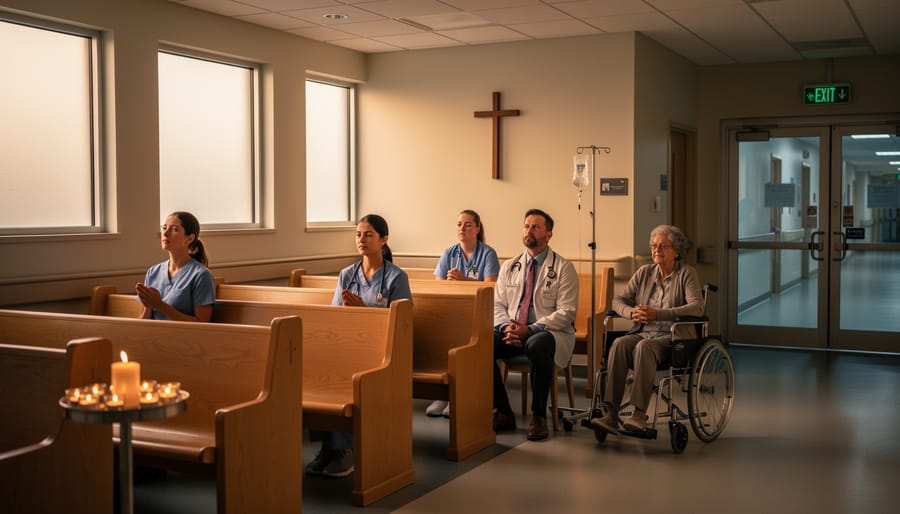
Hospital chaplaincy represents another vital context where healthcare chaplains support patients through prayer, sacraments, and spiritual care during medical crises. These trained ministers bridge the gap between clinical treatment and spiritual need, praying with patients before surgery, offering communion to the bedridden, and providing comfort to grieving families.
Personal devotion remains foundational. Believers pray privately for healing, fast while seeking God’s intervention, and claim Scripture promises over their bodies. Many keep prayer journals to track requests and recognize answered prayers over time.
The healthiest approach combines these practices with responsible medical care. Christians who embrace biblical wellness don’t view doctors and prayer as competing options but as complementary gifts from a God who heals through multiple means. They consult physicians while also asking their church to pray, trusting that God directs both the surgeon’s hands and the Spirit’s work.
What the Bible Actually Says About Healers
The biblical record establishes healing as a genuine spiritual reality, though not always in ways we might expect.
In the Old Testament, God identified Himself as healer: “I am the LORD, who heals you” (Exodus 15:26). Prophets like Elijah and Elisha performed miraculous healings that demonstrated God’s power over illness and even death. When Naaman the Syrian was cleansed of leprosy through Elisha’s instruction to wash in the Jordan River, it confirmed that healing flowed from God’s authority, not human ability (2 Kings 5:1-14).
Jesus modeled the fullest expression of spiritual healing during His earthly ministry. The Gospels document Him healing leprosy, blindness, paralysis, hemorrhages, and demonic oppression. He identified His healing work as evidence of His messianic identity: “The blind receive sight, the lame walk, those who have leprosy are cleansed” (Matthew 11:5). These weren’t theatrical performances but acts of compassion that restored people to community and wholeness.
After His resurrection, Jesus commissioned His disciples to continue this ministry. The book of Acts records Peter healing a lame beggar at the temple gate (Acts 3:1-10) and Paul restoring Eutychus to life after a fatal fall (Acts 20:9-12). These healings authenticated the gospel message and demonstrated God’s kingdom breaking into present reality.
Paul’s letter to the Corinthians lists “gifts of healing” among the spiritual gifts distributed by the Holy Spirit (1 Corinthians 12:9). This indicates that some believers receive a special gifting for healing ministry, though all Christians can pray for the sick. James instructs the church: “Is anyone among you sick? Let them call the elders of the church to pray over them and anoint them with oil in the name of the Lord” (James 5:14).
Yet Scripture also reveals that healing doesn’t always follow our preferred timeline. Paul asked God three times to remove his “thorn in the flesh,” but God’s response was, “My grace is sufficient for you” (2 Corinthians 12:9). Paul advised Timothy to use wine for his stomach ailments rather than promising instant healing (1 Timothy 5:23). These examples show that God’s purposes sometimes include physical weakness as a means of spiritual growth.
The biblical evidence confirms that spiritual healing through God’s power is genuine, while reminding us that God’s wisdom transcends our immediate desires for relief.
Common Questions About Spiritual Healing and Faith
When questions about spiritual healing arise, many believers find themselves wrestling with doubts and confusion. These concerns are valid and deserve thoughtful, biblical responses that honor both God’s sovereignty and human experience.
Why aren’t all prayers for healing answered the way we hope?
God hears every prayer, but His perspective encompasses eternity while ours is limited to the present moment. Sometimes He answers “not yet” or “I have something better,” trusting us to walk by faith even when we cannot see the full picture.
Can Christians visit spiritual healers from other traditions?
Scripture warns believers to test every spirit and avoid practices rooted in other spiritual systems (1 John 4:1). While we can appreciate medical professionals of any faith, seeking healing through non-Christian spiritual practices opens doors to influences that contradict biblical teaching.
How do we recognize false healers and charlatans?
False healers often prioritize money, spotlight their own power rather than glorifying God, and promise guaranteed results. Genuine Christian healing ministry points people to Jesus, never demands payment, and acknowledges God’s sovereignty in all outcomes.
Is lack of healing a sign of weak faith?
Absolutely not. Paul himself prayed three times for healing from his “thorn in the flesh” and received the answer that God’s grace was sufficient (2 Corinthians 12:7-9). Faith is not measured by physical outcomes but by trust in God’s character regardless of circumstances.
Maintaining faith in illness presents one of the Christian life’s greatest challenges. When healing seems delayed or denied, believers can feel abandoned or wonder if God is truly listening. Yet Scripture repeatedly shows us that suffering can deepen our dependence on God and refine our character in ways prosperity never could.
The question of unanswered prayer touches the mystery of divine sovereignty. God’s “no” or “wait” does not indicate lack of love or power. Consider that Jesus himself prayed in Gethsemane for his suffering to pass, yet ultimately submitted to the Father’s will. This pattern of honest petition followed by surrender offers us a model for our own prayers.
Some Christians struggle with guilt when healing does not come, wondering if hidden sin or insufficient faith blocks God’s response. While unconfessed sin can hinder our relationship with God, chronic illness or disability is not divine punishment for personal failings. Job’s friends made this mistake, and God rebuked them for it. Physical suffering in a fallen world affects the faithful and faithless alike.
The key is approaching spiritual healing with both hope and humility, expecting God to work while releasing our tight grip on specific outcomes. We pray boldly because Scripture invites us to, but we trust completely because God’s wisdom surpasses our understanding.
So, are spiritual healers real? The answer depends on what we mean by “real.” Healing through God’s power is absolutely real. Throughout Scripture and across centuries of Christian witness, we see authentic examples of divine healing through prayer, faith, and the work of the Holy Spirit. The spiritual gift of healing exists and continues to operate in the body of Christ today.
But discernment is essential. Not every practice labeled “spiritual healing” aligns with biblical truth. Not every claim of supernatural power comes from God. We’re called to test everything against Scripture, to seek God first in all things, and to approach healing ministries with both faith and wisdom.
If you’re wrestling with illness or seeking healing, start with prayer. Bring your needs before God honestly, knowing He hears and cares deeply for you. Connect with your faith community for prayers for healing and recovery. Explore biblical spiritual disciplines for spiritual growth that draw you closer to Him. Lean on the comfort of Bible verses about hope and strength when the waiting feels long.
Remember that God’s timeline isn’t always ours, and His definition of healing sometimes differs from what we expect. Yet His love never wavers, His presence never leaves, and His ultimate plan is always for our good. Trust Him with both your questions and your faith.