
A 5C leadership foundation is a simple framework that helps you lead creation care ministry with steadiness and joy: five habits, each starting with the letter C, that you build in order over a few weeks. If you’re a church volunteer, small group leader, or pastor, you can start with nothing more than a Bible, a notebook, and a willing heart. Expect to spend about thirty minutes a week for five weeks, and no prior experience is needed.
Why does it work? Because Scripture never treats care for creation as a side project. It begins in Genesis 2:15, where God places humanity in the garden “to work it and take care of it.” Leadership in this ministry is mostly that: faithful tending, done together, one small step at a time. A framework keeps you from burning out on big ideas and gives your team a shared language.
Think of a small group leader who starts a creation care team with grand plans for a church-wide project, then watches interest fade by spring. The framework protects against that. It asks you to listen before you launch, to build people before programs, and to measure progress by faithfulness rather than size.
Whatever your tradition, you’ll find room here. The steps below are practical, gentle, and open to your own congregation’s rhythms.
What a 5C Leadership Foundation Means for Creation Care Ministries
Why Leaders Need a Foundation Before a Program
Enthusiasm is a wonderful beginning, but it rarely carries a ministry for long. Many creation care efforts start with a burst of energy, a planting day or a clean-up, and then quietly fade when the first volunteer gets busy or the first season ends. Without something deeper underneath, the work depends on one person’s momentum, and momentum runs out.
A leadership foundation changes that. When a leader is rooted in calling, character, and community, the work can grow steadily, survive busy seasons, and pass from one set of hands to the next. It also keeps the motivation pointed in the right direction. We care for creation because “the earth is the Lord’s, and everything in it” (Psalm 24:1), and because in Christ “all things were created,” and in him “all things hold together” (Colossians 1:16-17). Our efforts flow from worship and gratitude, not from trend or pressure.
That is why growing in biblical leadership qualities matters before you launch anything. Humility, patience, and faithfulness are what keep a ministry going long after the excitement settles. Build the roots first, and the fruit will follow in its season.
What You Need Before You Begin: Tools and Materials for Leadership Formation

Good news: you can begin building your 5C foundation with very little. Most of what a leader needs is already within reach, and none of it requires special training or a big budget. What matters most is a willing heart and a few simple tools to help you listen, learn, and walk alongside others.
Here is a short checklist to gather before you take your first step:
- A Bible you love to open, plus a study journal for notes and prayers.
- A prayer partner or small team who will pray with you and keep you encouraged.
- A volunteer list, even if it starts with just two or three names.
- A short list of local creation care needs, such as a neglected green space or a community clean-up.
- A meeting space, whether a church classroom, a living room, or a shady spot outdoors.
- One study resource, such as a devotional or study guide from a Christian bookstore.
Think of the journal as your companion. Jot down verses that stir you, questions you’re wrestling with, and small answers to prayer. Over time, it becomes a record of how God is shaping you as a leader.
Time is the resource people forget. Set aside a regular slot on your calendar, even thirty minutes a week, so your leadership has room to grow. Small, steady moments of prayer and preparation do more than occasional bursts of energy.
If you’re wondering whether you’re “ready enough,” take heart. Moses had a staff and a stammer, and God used him anyway. Start with what you have, trusting that the One who calls you will supply the rest.
Before You Step Forward: Cautions and Gentle Stop Points for Ministry Leaders

Caring for creation is joyful work, but wise leaders know when to slow down. Think of these cautions as acts of love for the people you serve, and of humility before the God who called you.
Start with the practical side of outdoor and hands-on projects. Get permission before you dig, plant, or clean up on any property, whether it belongs to the church, a neighbor, or the city. Check that tools are in good working order, and match tasks to ages: little ones can water seedlings, while sharp tools and heavy lifting belong to capable adults. Keep an eye on the forecast, bring water and sun protection, and keep a first aid kit within reach, along with the name of someone trained to use it.
Then there is the people side. It is easy to pour yourself out until nothing is left, so protect your own rest as carefully as you protect your volunteers’. Invite others warmly rather than pressuring them, and remember that sincere believers hold different views on how creation care should look. This is where Christ-centered leadership shows its strength: listening first, serving gently, and valuing unity above any single project.
Seek the blessing of your pastor or ministry board before you begin, and keep them informed along the way. Proverbs 11:14 reminds us, “In an abundance of counselors there is safety.” If a project begins to cause division, setting it down for a season is not failure. It is faithfulness, and it keeps the door open for God to work.
How to Build Your 5C Foundation, Step by Step
Step 1: Confirm Your Calling Through Prayer and Scripture
Calling is the root of the other four Cs, so begin there, with prayer rather than a to-do list. Ask God gently whether he is inviting you to tend his creation, and then listen. Read Genesis 1:28 and Psalm 8 slowly, noticing how humanity is entrusted with care, not just given control.
Here are a few reflection questions for your journal:
– When have I felt most grateful for the natural world?
– What need in my church or neighborhood keeps coming to mind?
– What small step could I take without waiting to feel ready?
Consider Margaret, a retired schoolteacher who noticed the church lawn was thick with discarded coffee cups after Sunday service. Picking them up one morning, she felt a quiet nudge: someone should care for this place. That ordinary moment became her yes.
As you pray, keep the whole path in view:
- Confirm your Calling through prayer and Scripture.
- Cultivate Character that reflects Christ.
- Develop Competence by learning and practicing.
- Build Community across generations and traditions.
- Commit to Care for Creation through simple, lasting actions.
Your calling may begin as a whisper, and that is enough.
Step 2: Cultivate Character That Reflects Christ
Calling points you toward the work, but character determines how you carry it. The second C asks what kind of leader you are becoming along the way. Think of humility, patience, and servant-heartedness as roots. You can’t see them above the soil, yet they hold everything steady when storms come.
Paul describes this inner life in Galatians 5:22-23: “the fruit of the Spirit is love, joy, peace, forbearance, kindness, goodness, faithfulness, gentleness and self-control.” Notice that it is fruit, something God grows in us rather than something we manufacture. Our part is to stay close to the vine.
Here is one daily habit to try this week. Take a ten-minute prayer walk outdoors, around the block or through a nearby park. Pay attention to a tree, a patch of grass, a bird. Ask God to grow one quality from that list in you, and thank him for what you notice. Over time, the walk quietly shapes the leader.
Step 3: Develop Competence Through Learning and Practice
Competence grows the same way a garden does: gradually, with patience and a willingness to get your hands a little dirty. You don’t need to master everything before you begin. Start with one small area and learn as you go.
Begin in Scripture. Choose a short passage, such as Psalm 104 or Genesis 2:15, and read it slowly each week, asking what it teaches about how God cares for the world and how we are invited to share in that care. Write down one practical idea in your study journal.
Then look nearby. Many communities have gardening clubs, conservation volunteers, or community garden coordinators who welcome newcomers. Spend a morning working beside them, ask questions, and notice what they do well. A few hours with an experienced neighbor often teaches more than a stack of books.
Finally, make room for structured learning. Leadership Education for Creation Care Ministries resources can help you grow alongside other creation care stewards offering steady guidance as your skills and confidence develop.
Step 4: Build Community Across Generations and Traditions

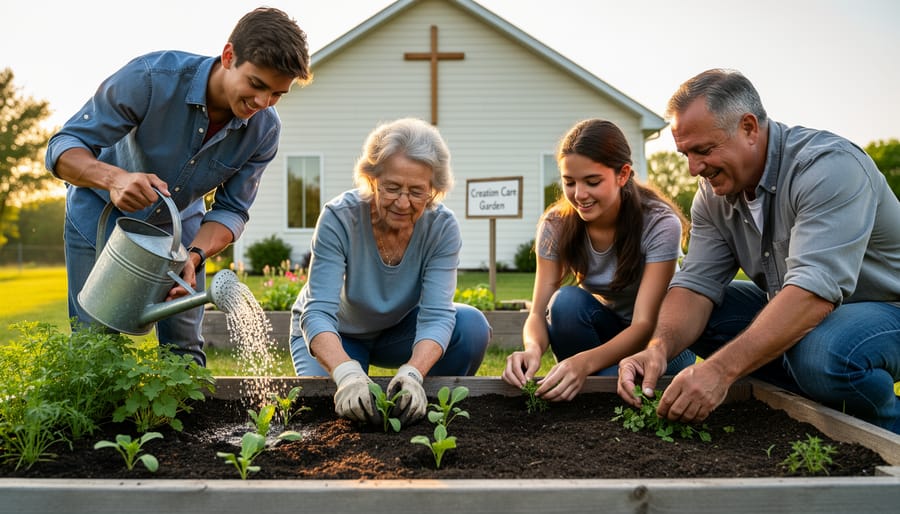
Community grows when people feel genuinely wanted. Start with a simple, personal invitation: a handwritten note, a phone call, or a conversation after worship. Children can plant seeds or water seedlings, seniors can share decades of gardening wisdom, and new believers often bring fresh wonder at God’s creation. Pairing generations on small tasks lets each side learn from the other, and it fits naturally with youth discipleship in your congregation.
Reach beyond your own pews, too. Neighbors from other Christian traditions may worship differently, yet many share a love for tending the earth. Invite them to a workday or a shared meal without any pressure to agree on everything.
Share leadership early. Ask one person to lead the opening prayer, another to organize supplies, another to welcome newcomers. Then mark the seasons together with a harvest gathering or a gratitude service, thanking God for what has grown. As Psalm 133:1 reminds us, it is good and pleasant when God’s people live together in unity.
Step 5: Commit to Care for Creation Through Simple, Lasting Actions
You’ve confirmed your calling, grown in character, built your skills, and gathered a community. Now it’s time to put your hands to the work. The fifth C is about turning conviction into one small, lasting action.
Pick one project and do it well. A church garden bed, a neighborhood clean-up, a creation-themed prayer service, or a plan to cut waste at coffee hour are all worthy beginnings. Choose what fits your people, your space, and your season. A congregation of twelve can plant tomatoes just as faithfully as a congregation of two hundred.
Here is a simple way to start this week:
– Name your project in one sentence.
– Set a date within the next month.
– Invite two or three people to help.
– Open with a short prayer of thanks for the gift of creation.
Remember that you are not aiming for perfection. A crooked row of lettuce still feeds the hungry, and a modest clean-up still honors the One who made the land. As Psalm 104:24 reminds us, “How many are your works, Lord!” Let gratitude, not pressure, carry the work forward.
Checking Your Progress and Planning Your Next Steps
A strong foundation shows itself quietly. You won’t need a big launch to know it’s working. Look for small, steady signs that the roots are taking hold, and treat them as an encouragement to keep going in biblical leadership one faithful step at a time.
- A small team is in place and sharing the work.
- A regular rhythm of prayer is part of your gatherings.
- Your first project has been completed, however modest.
- You’ve gathered honest feedback from members and neighbors.
- Your next gathering is on the calendar.
If a few of these feel missing, don’t be discouraged. Slow down, pray with your team, and shrink the next project until it fits your season. Sometimes the kindest adjustment is simply inviting one more person to help.
When you’re ready for next steps, consider a leadership gathering, a harvest or gratitude service, or a short study group. You can also explore Bible study resources and volunteering opportunities through Key Way Canada.
Common Questions About Leading Creation Care in Your Church
Do I need experience to lead?
No. Start with prayer, curiosity, and a willingness to learn alongside others.
What if my church is small?
A small team is plenty. One garden bed or one prayer service is a faithful beginning.
How do I respond when members disagree?
Listen first, keep the focus on Scripture and shared gratitude, and pause if tension grows.
How long until we see fruit?
Often a full season or more. Steady, patient steps matter more than speed.
Youth and small groups can use these same five steps with age-appropriate tasks, and many find that younger members bring wonderful energy.
Faithful leadership rarely arrives all at once. It grows the way a garden does, through small, patient acts of tending: a prayer offered, a seed planted, a neighbor welcomed. Your Calling, Character, Competence, Community, and Care for Creation will deepen with each step you take, and God honors every one of them.
May the Lord who made heaven and earth steady your hands, soften your heart, and surround you with people who share your joy. May your ministry bear fruit that outlasts you.
When you’re ready for more, we warmly invite you to explore Key Way Canada’s Bible study and prayer resources as you keep growing.