
When Paul urged the believers in Ephesus and Colossae to speak to one another in “psalms and hymns and spiritual songs,” he was describing three kinds of sung worship that still shape the church today. Psalms are the sacred songs found in the Old Testament book of Psalms. Hymns are songs of praise and doctrine that honour God and tell the story of what Christ has done. Spiritual songs are the Spirit-led, often spontaneous expressions of the heart, the kind of music that rises up in a moment of gratitude or longing.
The lines between the three blur at the edges, and that’s fine. Paul wasn’t handing out a strict musical rulebook. He was painting a picture of a worshipping community where Scripture, truth, and heartfelt joy all find a voice. Believers across many traditions, from quiet liturgical services to lively gatherings with a full band, have found their own way into this same three-part rhythm.
Understanding the difference can change how you sing on Sunday morning, or how you hum a verse while washing dishes on a Tuesday. It can also open up the season-by-season treasures of the church, from Advent carols to Easter anthems. Let’s look at what each term meant to Paul’s first readers, and what it can mean for your worship today.
Where the Three Words Come From in Scripture
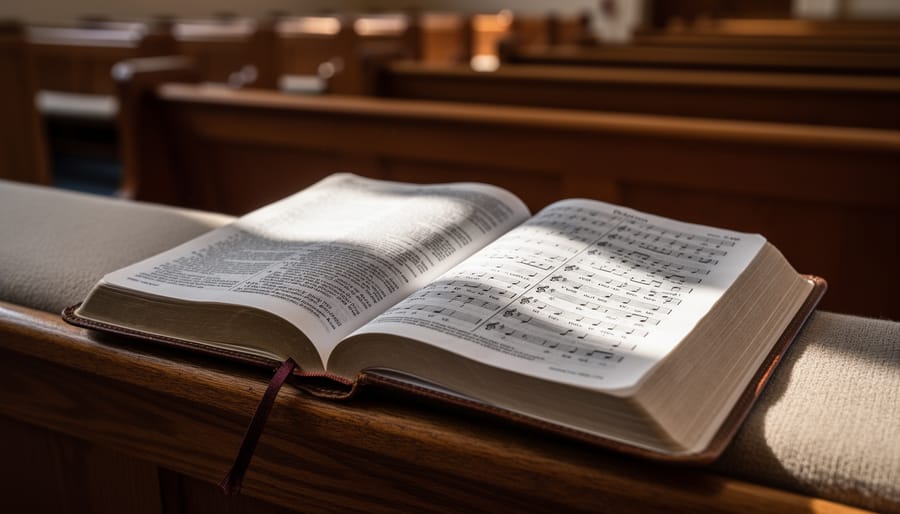
Two short passages hold the whole phrase. In Ephesians 5:19, Paul urges believers to speak “to one another with psalms, hymns, and songs from the Spirit,” singing and making music from the heart to the Lord. In Colossians 3:16, he says to let the word of Christ dwell richly among you “as you teach and admonish one another with all wisdom through psalms, hymns, and songs from the Spirit, singing to God with gratitude in your hearts.”
Notice what these verses have in common. Singing is never only about the singer. It teaches, it gently corrects, it encourages, and it gives thanks. Song becomes a shared way of carrying God’s word in the heart and handing it to the person beside you.
The three Greek terms (psalmoi, hymnoi, and odai pneumatikai) would not have sounded strange to the first readers. Psalmoi pointed to the sacred songs of Israel, hymnoi to songs of praise, and odai pneumatikai to songs shaped by the Spirit. These were familiar words from the worship life of the early church.
Scripture also shows us singing at its most memorable moments. After the Last Supper, Jesus and his disciples sung a hymn before walking out to the Mount of Olives (Matthew 26:30). Picture that quiet walk into a night they did not yet understand, with a song still on their lips. Later, Paul and Silas, beaten and locked in a Philippian prison, were praying and singing hymns to God at midnight while the other prisoners listened (Acts 16:25). In both scenes, song carried faith through fear.
Christians have drawn the lines between the three terms in different ways. Some see sharp distinctions, while others see overlap, and faithful believers hold both views. What every tradition can agree on is Paul’s purpose: song that fills us with Christ’s word.
Understanding Each Kind of Song
Psalms: Praying the Songbook of the Bible
The book of Psalms holds 150 songs and prayers, and it served as Israel’s prayer book long before it became the church’s songbook. These were the words God’s people sang in the temple, on pilgrimage to Jerusalem, and around their own tables. They still carry the full range of human experience before God.
Some psalms burst with praise. Others cry out in lament, honest about fear, grief, and even doubt. Some overflow with thanksgiving for prayers answered, and many rest in quiet trust that God is near. If you have ever struggled to find words for how you feel, the Psalms have probably already said it for you.
Jesus knew these songs well. He quoted the Psalms during His ministry, and even on the cross He spoke their words, echoing Psalm 22. Christians across the centuries have followed His example. Monastic communities chanted the Psalms daily, Reformed congregations sang metrical versions, and many churches today read them aloud or set them to fresh melodies.
Consider Psalm 23, “The Lord is my shepherd; I shall not want.” Families have whispered it at hospital bedsides and graveside services because it reminds us we are never walking alone. Psalm 100 offers a different gift: “Make a joyful noise unto the Lord, all ye lands.” One steadies the weary heart, the other lifts a grateful one. Together they show why the Psalms remain a trusted companion for worship.
Hymns: Songs of Praise and Truth Passed Down
A hymn, at its heart, is a song the whole congregation can sing together. Where a psalm gives us the words of Scripture itself, a hymn is composed by believers to say, in rhythm and rhyme, what we hold in common about God. That shared quality is what makes hymns so lovely to sing side by side.
The New Testament itself seems to preserve some of the earliest examples. Many readers see Philippians 2:6-11 as an early Christian hymn, with its soaring picture of Christ, who “being in very nature God,” humbled himself and was exalted above every name. Similar fragments appear in Colossians 1:15-20 and 1 Timothy 3:16, suggesting that the first believers were already putting their faith into song.
Hymns tend to carry strong poetic structure: verses that build on one another, a steady meter, and often a refrain that lingers in the heart. That is why so many of us can recall a hymn from childhood long after we’ve forgotten a sermon. “Amazing Grace” tells one person’s story of being found and forgiven. “Holy, Holy, Holy” lifts our eyes to the greatness and holiness of the Trinity. Neither belongs to one denomination; they are sung in many kinds of churches around the world.
This is the quiet gift of the hymn. It takes deep truths about God’s grace, holiness, and faithfulness and wraps them in a melody we can carry with us, a little songbook of belief we can sing on ordinary days and difficult ones alike.
Spiritual Songs: Heartfelt Expressions Inspired by the Spirit
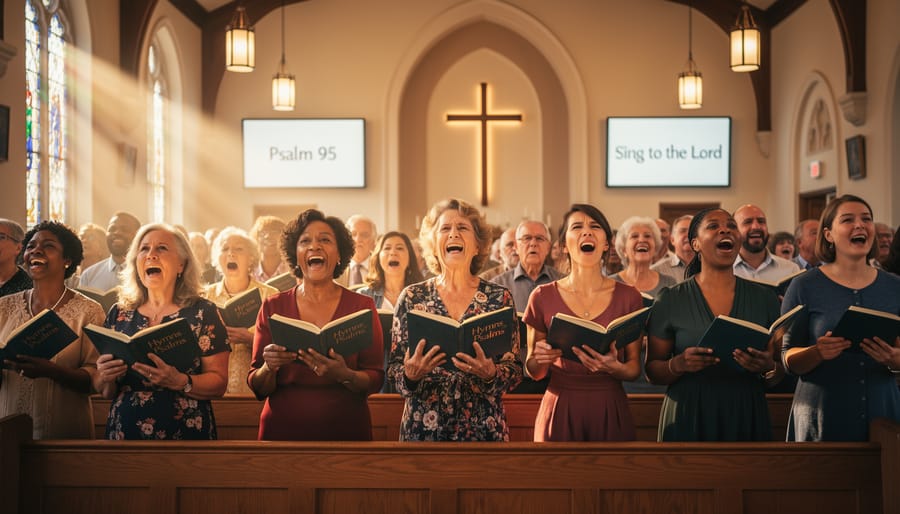
The third word in Paul’s phrase, “spiritual songs,” is the most open-ended of the three. The Greek calls them odai pneumatikai, literally songs of the Spirit, and many believers understand them as worship that rises up from the heart, whether it is planned or spontaneous.
Scripture gives us some beautiful glimpses of this kind of singing. Mary’s song of praise in Luke 1 pours out of her in response to what God is doing. Paul writes in 1 Corinthians 14:15, “I will sing with my spirit, but I will also sing with my understanding.” In both cases, the song comes from a heart moved by God.
Today, many Christians see spiritual songs reflected in contemporary worship songs and simple choruses. They also see them in the quiet tune someone makes up while praying, or a personal song of testimony that tells what the Lord has done in a life. A new song of thanks after a hard season can be just as much a spiritual song as anything sung on a Sunday morning.
What matters most is sincerity. A spiritual song doesn’t need polished lyrics, a trained voice, or a particular musical style. Guitar or organ, gospel harmony or a hushed lullaby, all are welcome when they come from a grateful heart. As Paul says in Colossians 3:16, we sing “with gratitude in your hearts to God.”
A Short Look at How Christians Have Sung Through the Centuries
Singing has been part of Christian life from the very beginning, and the story reads like a family history with many voices joining in over time. The first believers sang the Psalms they already knew, weaving them into prayerful worship long before hymnals existed. Over the centuries, the songs changed shape, but the heart behind them stayed the same.
| Era | Style of Singing | Well-Known Example |
|---|---|---|
| Early church and medieval years | Unaccompanied chant and Psalm singing | “Of the Father’s Love Begotten” |
| Reformation | Congregational singing in the people’s language | “A Mighty Fortress Is Our God” |
| 1700s | Hymns of poetry and doctrine | “When I Survey the Wondrous Cross” (Isaac Watts) |
| 1800s | Gospel songs and spirituals | “Blessed Assurance” (Fanny Crosby) |
| Today | Contemporary worship songs | “How Great Is Our God” |
During the Reformation, church leaders such as Martin Luther encouraged ordinary people to sing in their own language, so the congregation could lift its voice rather than only listen. That opened the door for writers like Isaac Watts and Charles Wesley, who filled the church with hymns rich in Scripture. Fanny Crosby, who was blind from infancy, wrote thousands of songs that still comfort many of us. Alongside them, enslaved believers sang spirituals that carried both sorrow and unshakable hope, and gospel music grew from that same deep well.
Today’s worship songs and choruses are simply the newest verses in a very old song. Each generation has sung what helped it pray, remember, and trust. A quiet chant, a rousing hymn, and a heartfelt chorus can all invite the kind of meditation on Scripture that settles into the heart. Rather than a contest between styles, it is one church, many voices, singing together across the centuries.
Bringing Psalms, Hymns, and Spiritual Songs Into Everyday Faith

Singing can weave into nearly every part of daily life, and you don’t need a trained voice to begin.
In personal devotion, try reading a psalm aloud in the morning, then sing or hum a hymn verse as you start your day. Some people pair a psalm with a few reflection questions afterward, asking what the words reveal about God and what they stir in the heart. At family time, a simple bedtime hymn or a table-side doxology gives children a treasury of truth they can carry for life. In small groups, open with a spiritual song or a shared psalm reading to settle everyone’s hearts before the conversation begins. In church life, welcome the older hymns and the newer songs side by side, trusting that each has something to teach.
The seasons of the church year offer natural moments for all three kinds of song. Advent invites quiet psalms of longing and hymns of expectation. Christmas fills the home with carols of joy. Lent calls for reflective psalms of repentance, while Easter bursts into songs of resurrection. Thanksgiving, of course, pairs beautifully with Psalm 100.
Consider a grandmother standing at the sink after a funeral, humming “It Is Well with My Soul” without quite realizing it. Her grieving grandson, sitting nearby, begins to hum along. Neither says a word, yet the melody carries what neither can speak. That is the quiet gift of song: it keeps faith alive through life’s every season.
Common Questions About Psalms, Hymns, and Spiritual Songs
Are psalms, hymns, and spiritual songs really three different things?
Many Christians see a gentle distinction: psalms come from the biblical book of Psalms, hymns are crafted songs of praise and doctrine, and spiritual songs are heartfelt, Spirit-led expressions. Others believe the three terms overlap, so there’s room for different understandings.
Do we need to sing only Psalms, or only hymns?
Paul names all three together, which suggests variety rather than a single rule. Congregations across the Christian family follow different practices, and each can sing to the Lord with sincerity.
Can modern worship songs count as hymns?
Many believers say yes, especially when a song carries rich truth about God in a form people can sing together. Others would place newer songs under “spiritual songs,” and both views honor the same heart of worship.
What if I can’t sing well?
Scripture invites us to “make a joyful noise” (Psalm 100:1), not a perfect one. God looks at the heart, so sing quietly at home, hum along, or simply read the words as a prayer.
How can new believers get started?
Begin with a well-loved psalm such as Psalm 23 and one or two familiar hymns. A little at a time, you’ll find songs becoming part of how you pray and practice your faith day by day.
If one of these questions has been on your heart, you’re in good company. Believers of every age and background have wondered about the very same things, and the church has made room for those questions for centuries. The most encouraging truth is that there isn’t a single right way to lift a song to the Lord. Whether you sing from a worn hymnal, a printed psalter, a screen in a sanctuary, or the quiet of your own kitchen, the invitation stays the same: let gratitude and the word of Christ shape what rises from your heart.
Whether you sing from a worn hymnal, a Psalter, or the latest worship playlist, the invitation is the same: “Let the word of Christ dwell in you richly… singing psalms, hymns, and spiritual songs with gratitude in your hearts to God” (Colossians 3:16). Notice that Paul never asks for a trained voice. He asks for a thankful heart and a mind filled with Scripture. Every tradition brings something precious to this chorus, and none of us has to sing perfectly for God to be glad of our song.
If you’d like to go deeper, Key Way Canada offers Bible study resources and bookstore materials, including editions of the Psalms and hymnals, to help you explore these songs for yourself, your family, or your small group.
So hum a verse on the drive to work. Sing a psalm at the kitchen table. Lift up an old favourite or a brand-new song. However it sounds, sing with gratitude, and let the word of Christ fill your days.