
Art helps a hurting community heal because it gives people a way to say what words alone can’t hold. Painting, singing, writing, and making things together let grief, fear, and hope move out of the heart and into something shared, and a church can host that kind of gathering with a few tables, simple supplies, and an open invitation. No artistic skill is needed. Showing up is enough.
Scripture has long pointed this way. David poured sorrow into the Psalms, and Israel sang through exile and rescue alike. In Exodus, God filled Bezalel with skill and craftsmanship to make beauty for worship, a reminder that creativity is a gift meant to serve people in need. When hardship touches a whole congregation or neighbourhood, making something side by side says, without a lecture, that nobody carries this alone.
Below, we look at art forms that work well for groups, how to start your own gathering step by step, and answers to common questions, so you can offer comfort in a way that welcomes every age, background, and tradition.
Why Creativity Reaches Where Words Sometimes Cannot
The Psalms: Scripture’s Songbook of Lament and Hope
The Psalms may be the Bible’s clearest invitation to bring our whole hearts to God, creatively and without polish. David was a shepherd, a warrior, and a king, but he was also a songwriter who wrote from caves, battlefields, and sleepless nights. He didn’t tidy up his sorrow before offering it. “How long, Lord?” he asks, again and again, and the question itself becomes poetry.
What’s striking is how the psalmists hold grief and trust in the same breath. Many of these songs begin in anguish and end in hope, not because the pain vanished, but because singing it aloud made room for God’s comfort. Others stay in the dark a little longer, and Scripture keeps them anyway. Even the most honest lament is treated as worship.
This gives us real permission. If you’re hurting, you don’t need the right words or a theological answer. You can write a few lines, hum a tune, or simply echo a psalm that says what you can’t. Psalm 34:18 offers this promise: “The Lord is close to the brokenhearted and saves those who are crushed in spirit.” And Psalm 147:3 adds, “He heals the brokenhearted and binds up their wounds.”
Creative expression becomes one of the ways we meet that nearness.
Creative Ways Communities Can Walk Through Healing Together
Music and Worship as Shared Comfort
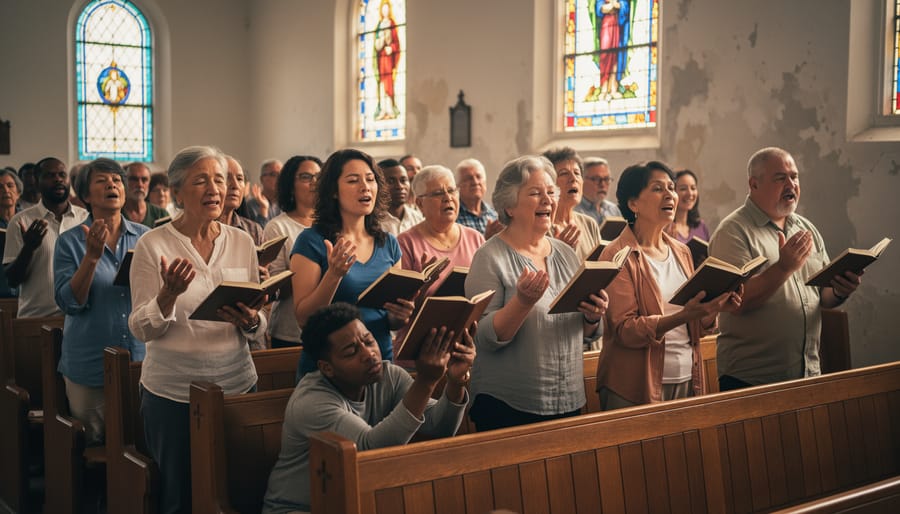
When words feel too heavy to carry, a familiar hymn can carry them for us. Singing together reminds a grieving community that no one is walking alone, and the melody holds what the voice can’t yet say. Quiet instrumental worship offers another gentle path, giving people room to sit, breathe, and pray without having to speak at all.
Writing songs together can be just as healing. A simple chorus built from Psalm 34:18, “The Lord is close to the brokenhearted,” gives shared grief a shape and a place to rest.
Picture a small congregation after a devastating flood. For weeks, Sunday gatherings were quiet and strained. One evening, an older member sat at the piano and began playing “It Is Well with My Soul.” One by one, voices joined in, some wavering, some in tears. Nobody preached or explained anything. Afterward, neighbors lingered, sharing coffee and stories for the first time since the water rose. The song had opened a door that conversation couldn’t.
This kind of gathering fits naturally within a broader approach to care after crisis where listening comes first and comfort is offered without pressure. You don’t need a polished choir, only willing hearts and a few familiar songs.
Visual Art, Murals, and Handcrafts That Tell a Story of Hope
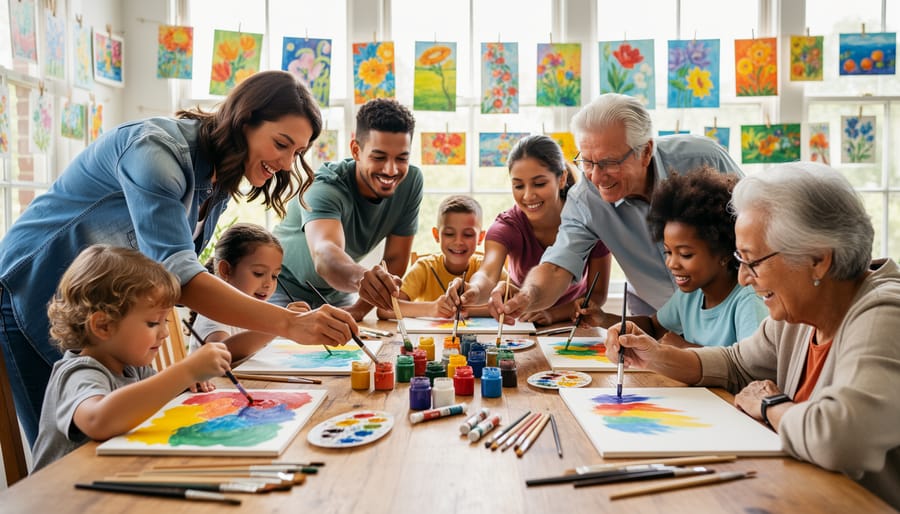
When words feel too heavy, our hands can sometimes carry the load. Painting, planting, and crafting give grieving people something solid to hold, and something good to build together.
Scripture honors this kind of work. In Exodus 31, God fills Bezalel with skill and ability to craft beautiful things for His people’s worship. Handiwork was never an afterthought to Him. It is part of how He invites us to respond to Him, even in hard seasons.
Think of a community mural. Neighbors who might never have spoken to each other pick up brushes side by side, each adding a color, a symbol, or a verse. A memorial garden works the same way. Planting bulbs in the fall, tending them through winter, and watching them bloom in spring gives sorrow a living, growing shape. Craft circles, whether quilting, knitting, or pottery, offer a quieter rhythm. Hands stay busy, and conversation comes easily without anyone being pushed to share.
Ecclesiastes 3:4 reminds us there is “a time to weep and a time to laugh, a time to mourn and a time to dance.” Creative work holds space for both. Tears and laughter often show up at the same table, and that is part of healing.
Storytelling, Journaling, and Testimony

When loss has scrambled everything, putting it into words can bring a little order back. Telling a story gives grief a beginning, middle, and the hint of an ending. Writing a prayer or a few lines in a journal lets a person say what feels too heavy to speak aloud. Over time, many notice something they missed in the middle of the pain: moments of kindness, a neighbor’s meal, a verse that arrived at just the right hour. These small discoveries often become quiet testimony of God’s presence in a hard season.
In a group, you might offer simple prompts like “Where did you feel held this week?” or “Write a prayer you don’t yet know how to pray.” Keep paper and pens within easy reach.
Above all, honor each person’s pace. Some will want to share right away, while others will simply listen for weeks, and that is perfectly fine. Let sharing always be an invitation, never an expectation. Psalm 56:8 reminds us that God keeps count of our tossings and collects our tears, so no story is ever unheard.
A Story of Healing Through Making Together
Picture a small neighborhood church a few months after a flood swept through the area. Homes had been repaired, but a heaviness still hung over the community. People waved politely at one another and said they were “doing okay,” though few believed it.
A volunteer suggested something simple: a table in the fellowship hall, a stack of salvaged ceramic tiles, and a few jars of paint. No one was asked to be an artist. The invitation was only to come and make something.
At first, the room was quiet. An older man painted a single blue line across his tile and said nothing. A teenager traced the outline of her family’s front porch. A mother sat beside them, slowly pressing small pieces of broken tile into a mosaic. Somewhere in the second hour, a woman began talking about the night the water rose, almost to herself. Nobody rushed to fix it or fill the silence. They kept working and kept listening.
Over several weeks, the gathering grew. Tiles became a mosaic bench for the church garden, each piece carrying a bit of someone’s story. People spoke honestly about fear, anger, and what they had lost. They also spoke about the neighbors who showed up with boots and casseroles. Many later said they had begun to see God’s purpose in crisis not as an answer to every question, but as His steady nearness through the people around them.
This story is a composite, a picture of what often happens when people make something together. Connection comes first, then honest conversation, and slowly, hope.
How to Start an Arts-Based Healing Gathering in Your Church or Neighborhood
Starting an arts-based healing gathering is simpler than most people expect. You don’t need a studio, a budget, or a single artist in the room. What you need is a willing heart and a willingness to listen, much like the encouragement in James 1:19 to be “quick to listen, slow to speak.” A small, steady gathering often does more good than a big event.
Here’s a practical way to begin:
- Listen first. Talk with neighbors, pastors, and church members about what they’re carrying. Ask what would feel helpful, not what you think they need.
- Gather a small team. Two or three caring people are plenty. Choose folks who are patient and good at making others feel at ease.
- Choose one simple activity. Think group singing, painting on small canvases, writing a short prayer, or making something together. Pick one and keep it easy.
- Set a gentle, welcoming tone. Offer tea or coffee, soft seating, and an open invitation. Let people join in, watch, or simply sit quietly.
- Open and close with prayer or reflection. A short prayer, a Psalm, or a moment of silence helps everyone feel held by something bigger than the project.
- Follow up with care. Check in with anyone who seemed to be struggling, and quietly offer to connect them with further support.
A few things are worth remembering as you plan. Keep materials affordable and easy to handle, such as paper, pencils, watercolours, or yarn. Say clearly that no artistic skill is required, because the goal is expression, not performance. Many people hold back out of fear of “doing it wrong,” so remove that pressure early and often.
Invite without pushing. Some will want to share their story out loud, while others will only want to be near people who understand. Both are welcome. As Galatians 6:2 reminds us, we are called to “carry each other’s burdens,” and sometimes that just means showing up.
Finally, know the limits of a creative gathering. Art can open the door to healing, but it is not a replacement for professional help. Build relationships with trained counsellors, pastors, or local care professionals so you can gently refer someone when grief or trauma runs deeper than a group can hold.
Common Questions About Arts and Healing in Times of Crisis
Many people wonder where to begin, and it’s natural to have questions. Here are a few that come up often, answered with care for every tradition and comfort level.
Do I need to be artistic to take part?
Not at all. Arts-based gatherings are about expression, not performance, so a simple doodle, a hummed melody, or a few written lines is every bit as welcome as a finished masterpiece.
Is creative expression a substitute for professional counseling?
No. Creativity can be a gentle companion to healing, but it doesn’t replace trained counselors, doctors, or pastoral care professionals. If someone is struggling deeply, please encourage them to reach out for that support alongside any creative practice.
How can art be part of prayer?
Many believers find that drawing, writing, singing, or shaping something with their hands helps them sit quietly before God when words feel too heavy. The Psalms remind us that honest, creative expression has always had a place in our conversations with the Lord.
How soon after a crisis is it appropriate to begin?
There’s no single right timeline. Start by listening, invite gently, and let people join when they feel ready, since some will want to gather quickly while others need more time.
Children and older adults can take part too, and their presence often enriches the whole gathering. Little ones may prefer colors, clay, or simple songs, while elders can share stories and memories that connect the community across generations. Offering a few different options, from seated crafts to quiet listening, helps everyone find a place at the table.
If you’re looking for ongoing fellowship and encouragement beyond a single gathering, consider joining one of the Bible study groups that can walk with you through both ordinary days and hard seasons. Healing rarely happens alone, and every small, faithful step toward one another counts.
Healing rarely happens alone. Whether it begins with a hymn hummed in a quiet room, a paintbrush passed around a table, or a prayer written down and shared, creativity gives hurting people a gentle way to come together. And the promise of Psalm 34:18 holds through every season: “The Lord is close to the brokenhearted and saves those who are crushed in spirit.”
You don’t need to plan something large. Think of one small step you could take this week. Invite a neighbor to sketch with you, start a simple journaling circle after service, or gather a few friends to sing together. Go slowly, listen well, and let the work be imperfect.
If you’d like more encouragement along the way, Key Way Canada offers Bible study, prayer, and community resources to help you take that step with confidence and care.